Background:
Long-acting antiretroviral formulations offer an innovative solution to support adherence in African women seeking HIV pre-exposure prophylaxis. Micro-tabletted tenofovir alafenamide (TAF), a potent antiretroviral drug with established systemic safety, was formulated in a silicone elastomer sub-dermal implant and tested for safety, tolerability, and pharmacokinetics (PK).
Methods:
Healthy, adult South African women at low HIV risk enrolled in the CAPRISA 018 Phase I trial. To assess initial safety, six women received a single TAF (110mg) implant with an estimated 0.25mg/day in vivo release rate for 4 weeks (Group 1). Thereafter, 30 women randomized 1:1 to either one or two TAF implants, assigned blinded in a 4:1 active (n=24) to placebo (n=6) ratio, for 48 weeks (Group 2). Implant safety (systemic and implant site reactions [ISRs]: frequency, severity grading, time to resolution), tolerability (scheduled vs early removals), and PK evaluations (TAF plasma concentrations, and active metabolite tenofovir diphosphate [TFV-DP] in peripheral blood mononuclear cells (PBMCs) with a target protection threshold set at 36 fmol/106 cells) were assessed throughout implant placement and 4 weeks post-removal.
Results:
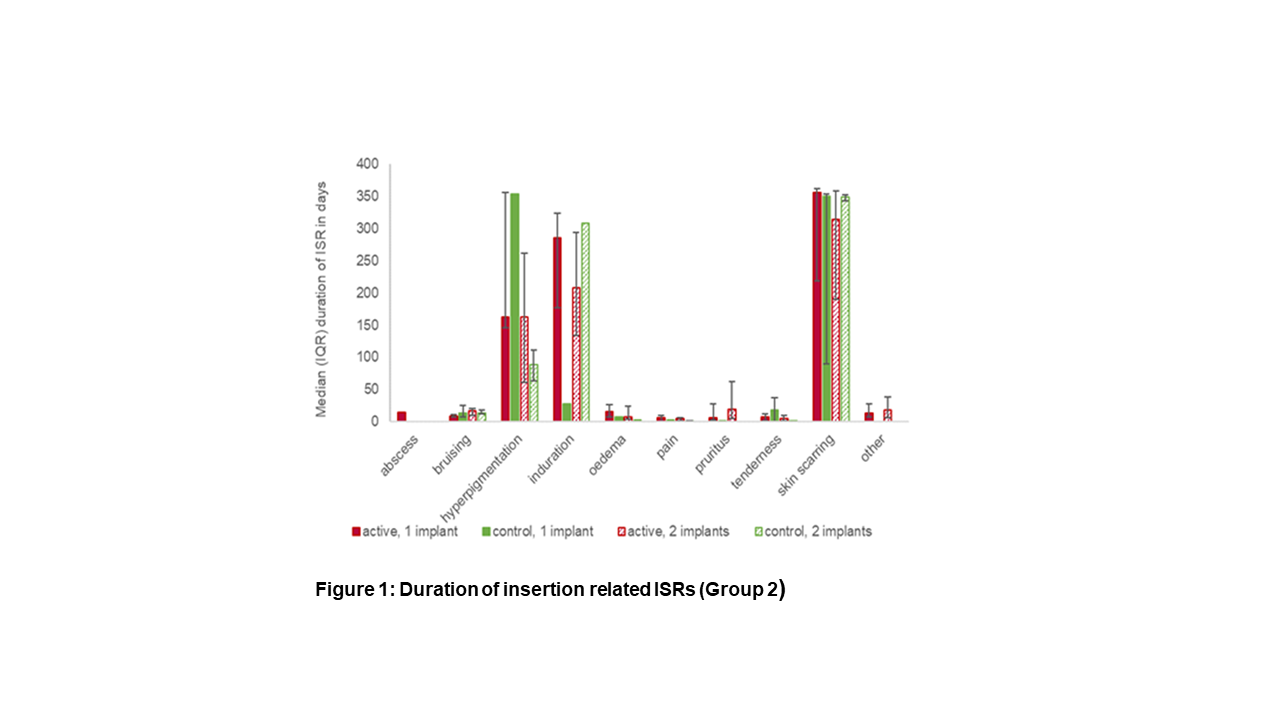
Study participant median age was 26 years and 13% had a history of contraceptive implant use. Common ISRs (Figure1) were mostly mild (Grade 1) with scarring, hyperpigmentation, and induration, continuing for the duration of the study. In Group 2, Grade 3 ISRs, reported in two participants, resolved on implant removal. Early implant removal prior to 48 weeks occurred in 11 (37%) (10 active arm) in a median [IQR] of 19 [10-27] weeks post-insertion, mostly due to ISRs. Plasma TAF was detectable in 77% of samples from Group 2 participants in the active arm, with 100% and 50% detection 0.5 and 6 hours post insertion while median [IQR] TFV-DP concentrations were 3.9 [1.7-13.3] and 14.8 [6.0-29.1] fmol/million cells in women with 1 and 2 active implants respectively, with 15% of samples reaching or exceeding the target concentration
Conclusions:
In this first-in-human TAF implant trial, we found an expected safety profile, predominantly as insertion site reactions, but sub-optimal tolerability. Implant drug release rates did not reach targeted PBMC TFV-DP concentrations in most participants. Inserting additional implants or increasing release rates would need to be counter-balanced with the potential for increased side effects and reduced tolerability. Additional PK analyses are underway.