Background:
Among people with HIV (PWH), depression is a common psychiatric condition and an independent stroke risk factor. To clarify potential pathways in this association, we examined different levels and patterns of depressive symptom severity and incident stroke in PWH.
Methods:
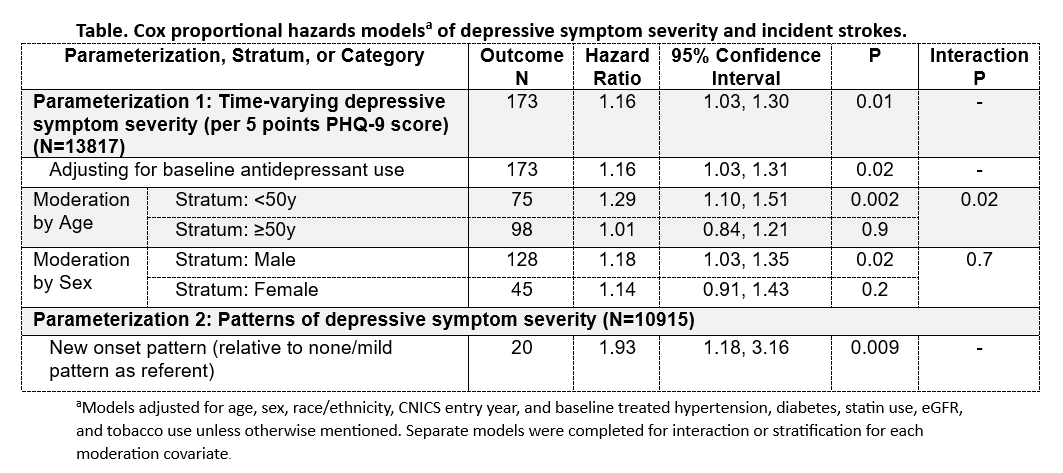
We studied adult PWH in clinical care at 5 US sites in the CFAR Network of Integrated Clinical Systems (CNICS) cohort with ≥1 assessment for self-reported depressive symptoms (PHQ-9) through 2022. Neurologists centrally adjudicated all strokes. Participants were followed from the closest encounter on/after the first PHQ-9 measure until stroke, death, loss to follow-up, or study end. A PHQ-9 score ≥10 was a positive screen for depression. We used adjusted Cox models to evaluate (1) associations between time-varying depressive symptom severity and incident stroke, (2) moderation of this relationship by age and sex, and (3) different patterns of depressive symptom severity. Patterns were based on whether the baseline and next PHQ-9 measure (median time between measures 224 days, IQR 140-461) had a positive screen for depression: (1) none/mild: negative screens for both, (2) new onset: negative then positive screen, (3) remitted: positive then negative screen, (4) persistent: positive screens for both.
Results:
Among 13817 PWH, at baseline, mean follow up was 7.6 years [SD 3.5], mean age was 45 years [SD 11], 19% were female, 58% reported non-white race/ethnicity, 78% had HIV RNA <200 copies/mL, and 23% screened positive for depression. A total of 173 had an incident stroke during follow up. Time-varying depressive symptom severity (per 5-pt PHQ-9 score) was associated with higher stroke risk (aHR 1.16, P=0.01) with greater impact in PWH <50y than ≥50y (Interaction P=0.02) but no significant difference by sex. Adjusting for baseline antidepressant use did not change the main estimate (aHR 1.16, P=0.02). New onset depressive symptoms were associated with the highest stroke risk among different patterns of depressive symptoms: none/mild (referent), new onset (aHR 1.93, P=0.009), remitted (aHR 1.31, P=0.3), persistent (aHR 1.31, P=0.1).
Conclusions:
Higher severity depressive symptoms were associated with higher stroke risk with greater impact in younger PWH. Stroke risk was considerably elevated with new onset depression. Findings suggest depression may be a modifiable stroke risk factor and potential benefits of early screening and interventions for depression, especially for younger PWH and those with new onset depression.