Background:
Racial disparities in cancer outcomes among people with HIV (PWH) have not been extensively explored in the context of HIV-specific clinical factors such as HIV viral load and immune status. We estimated 5-year survival and risk factors for 5-year mortality among PWH diagnosed with cancer in North America from 2000-2017.
Methods:
We included PWH, ≥18 years old, participating in the North American AIDS Cohort Collaboration on Research and Design, diagnosed with validated cancer between 2000-2017, with ICD-O-3 site/histology data. Patients were followed from age at cancer diagnosis to the earliest of: death, administrative censoring, loss-to-follow-up, or 5 years of follow-up. Cancers were categorized as AIDS-defining (ADC), virally-associated non-AIDS-defining (VAC), or non-AIDS-defining cancer (NADC). Patients could contribute multiple cancers. With age as the timescale, we estimated 5-year survival by cancer type (Kaplan-Meier). We assessed mortality risk factors at cancer diagnosis by cancer type using Cox proportional hazards models including race/ethnicity, viral suppression, CD4 count, AIDS-defining illness (ADI) prior to cancer, and calendar year of cancer diagnosis.
Results:
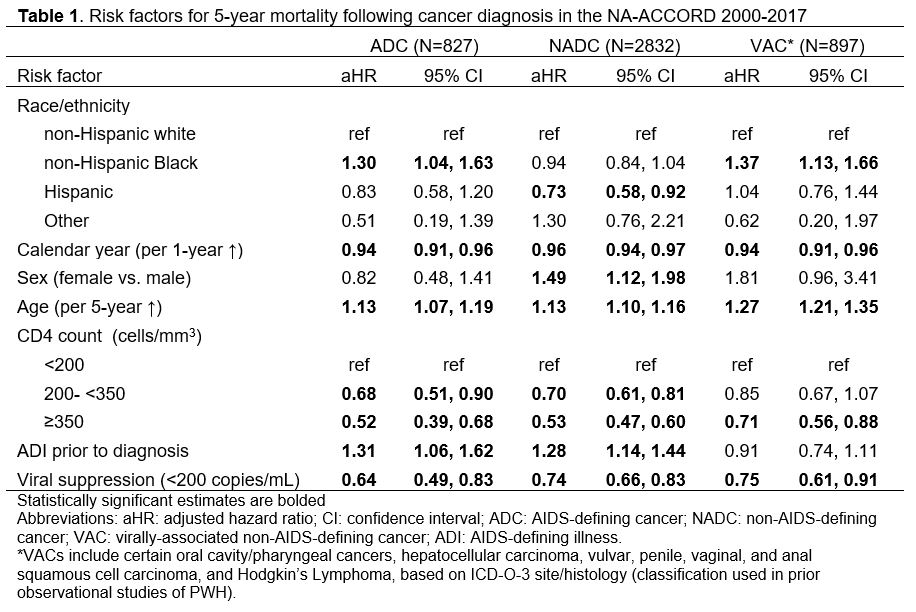
There were 4556 cancer diagnoses (827 ADC, 2832 NADC, 897 VAC) among 4103 patients contributing 12185 person-years. Five-year survival was 50.1% (46.2%, 53.8%) for ADCs, 38.5% (36.4, 40.6%) for NADCs, and 32.9% (29.1%, 36.7%) for VACs. Viral suppression and high CD4 count (≥350 cells/mm3) were inversely associated with 5-year mortality. Age was an independent predictor of mortality for all cancers. For ADCs and NADCs, ADI history was associated with increased mortality risk. Mortality following ADCs and VACs was higher in Black patients; and mortality following NADC was lower for Hispanic compared to white patients.
Conclusions:
Viral suppression and CD4 count were predictive of 5-year mortality following cancer diagnosis across cancer types. Inconsistent racial mortality disparities by cancer type merit further research. Future work will incorporate cancer treatment, screening, stage, and longitudinal HIV viremia/ immune status to comprehensively characterize this association. Associations with HIV-specific factors and NADCs/VACs underscore the importance of maintaining suppression and high CD4 count following cancer diagnosis and exploring the etiologic role of these factors in cancer progression.
Table 1. Risk factors for 5-year mortality following cancer diagnosis in the NA-ACCORD 2000-2017