Background:
Post-exposure prophylaxis (PEP) offers protection from HIV after unanticipated condomless sex, but is not widely available in a timely way in sub-Saharan Africa (SSA). We propose consideration of making tenofovir-lamivudine-dolutegravir (TLD) widely and freely locally available in communities without prescription (e.g. where condoms are made available, along with HIV self-test kits and emergency contraception), with community ownership and education, to enable PEP use within 24 hours of sex. Giving unrestricted access would mean drugs might also be used as PrEP, and as ART for people with HIV, without engagement in care, the net effects of which are uncertain.
Methods:
We used an existing individual-based model (HIV Synthesis). Beneficial effects of community TLD modelled: (i) higher PEP/PrEP coverage of new sex partnerships (ii) greater likelihood of HIV-diagnosed people being on ART (iii) some use of ART in people who have never been tested by the health care system, due to self-testing / self-starting ART; negative effects: (i) lack of initial / 3- monthly HIV testing in some PrEP users (ii) increase in proportion of people on ART who are not in care and not monitored (iii) increased risk of IRIS in people with starting ART without assessment of AHD (iv) some use of ART in people without HIV or a risk for HIV. Through sampling of parameter values we create “setting-scenarios” reflecting uncertainty in assumptions and a range of settings similar to those seen in SSA. For each setting scenario, we compare outcomes from 2022 between policies of (i) continuation of oral TDF/FTC PrEP availability only, and (ii) community availability of TLD/PEP. We assume a full 3 month (time step of the model) cost of TLD for 3-month periods in which PEP is used, and that TLD has no greater efficacy as PrEP than TDF/FTC.
Results:
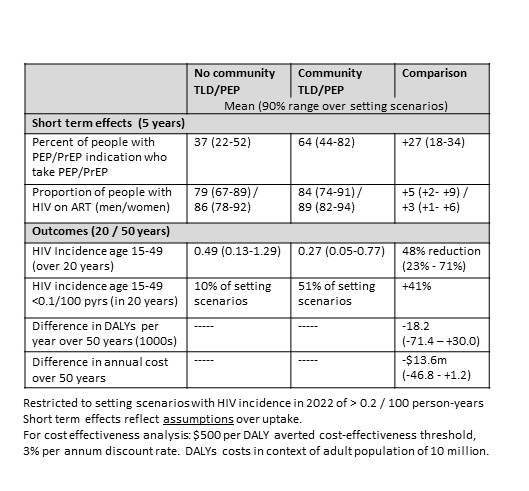
The modelled effects of community TLD availability result in a median (90% range over setting scenarios) reduction in incidence of 48% (23%-71%) over 20 years. Incidence in 20 years is < 1/100 person years in 50% of setting scenarios with community TLD/PEP. Overall, community availability of TLD has health benefits and is cost-saving. It is cost-effective in 84% of setting scenarios.
Conclusions:
Community availability of TLD/PEP has potential to be impactful and cost-effective, providing impetus for pilot evaluations to understand whether this potential can indeed be realized in practice. We provide a framework to allow results from such evaluations to inform policy.
Table. Modelled effect of community TLD/PEP across settings scenarios in sub-Saharan Africa