Background:
The pandemic response measures have had significant global economic and health impacts with transient reductions in HIV clinic attendance and self-reported anti-retroviral therapy (ART) adherence reported in prior studies. Since viral suppression (VS) is an indication of ART adherence and effective service delivery, we assessed VS in the context of the COVID-19 pandemic in 3 African countries
Methods:
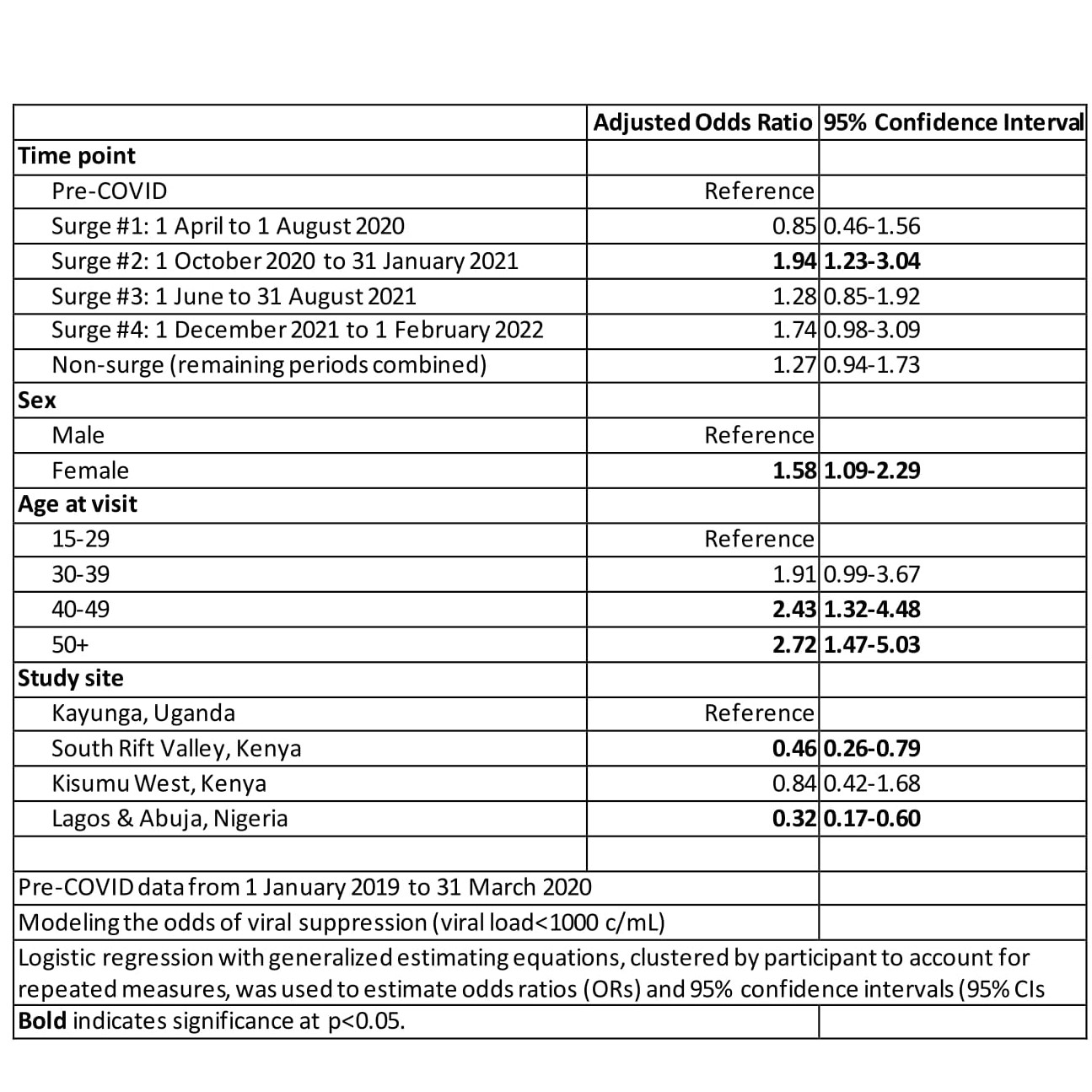
Since 2013, the African Cohort Study (AFRICOS) has enrolled individuals 18 years or older with and without HIV, in an approximate 5:1 ratio, at 12 clinics across 5 HIV care programs in Tanzania Uganda, Kenya, and Nigeria. For people living with HIV (PLWH), ART history was extracted from medical records and viral load was assessed at each visit. This abstract assesses VS (< 1000 c/ml) before and during the COVID-19 pandemic (categorized into 4 surges and a consolidated non-surge period; defined in Table 1) among PLWH. Tanzania was excluded due to inadequate pandemic data. Logistic regression with generalized estimating equations, clustered by participant, was used to estimate odds ratios (ORs) and 95% confidence intervals (CI) comparing VS before and during COVID-19. Models are adjusted for age, sex, and program.
Results:
Of the 1741 study participants, 368 are from Uganda, 1156 are from Kenya, and 217 are from Nigeria; 730 are males, 1011 are females, and 147 are under the age of 30. PLWH were less likely to be virally suppressed during the first surge period (OR 0.85, CI 0.46-1.56), but VS significantly increased during the second surge period (OR 1.95, CI 1.23-3.04) compared to the pre-COVID period. The third and fourth surge periods also saw a higher VS (table 1). Females are more likely to be virally suppressed than males (OR 1.58, CI 1.09-2.29) and PLWH ages 40-49 have higher VS (OR 2.43, CI 1.32-4.48) compared to PLWH under. PLWH at the AFRICOS sites in Kenya and Nigeria show lower VS than the Ugandan cohort (ORs 0.46, CI 0.26-0.79 and OR 0.32, CI 0.17-0.60 respectively).
Conclusions:
The initial drop in VS may be attributed to reduced clinic access due to lockdowns. Many HIV programs supported by the President’s Emergency Plan for AIDS Relief (PEPFAR) adapted their strategies to serve PLWH by scaling up community ART dispensing and multi-month dispensing (MMD) of ART for stable clients, which could have led to increased VS during the other surge periods. These findings demonstrate sustained progress made by PEPFAR-supported programs against the HIV epidemic amidst the COVID-19 pandemic
Table 1: Adjusted Odds Ratios of Viral Load Suppression during COVID Pandemic, AFRICOS Sites, March 2020 to June 2022