Background:
TDF and FTC have been evaluated for safety among pregnant and lactating people taking PrEP. Prior safety studies measured exposure using self-reported recent adherence, which may over or under-report actual use. This is one of the first studies to compare pregnancy and birth outcomes using objective levels of tenofovir diphosphate (TDF-DP) in dried blood spots (DBS) of women in the 2nd or 3rd trimester of pregnancy.
Methods:
We enrolled pregnant women >15 years old without HIV at first antenatal care visit and offered them PrEP following HIV counseling. We quantified TDF-DP levels in DBS in pregnant women who reported taking PrEP in the past 30-days in the 2nd or 3rd trimester. We used logistic regression models with generalized estimating equations to evaluate pregnancy and birth outcomes by TFV-DP (any vs. none), adjusting for age, gestational age and gravidity.
Results:
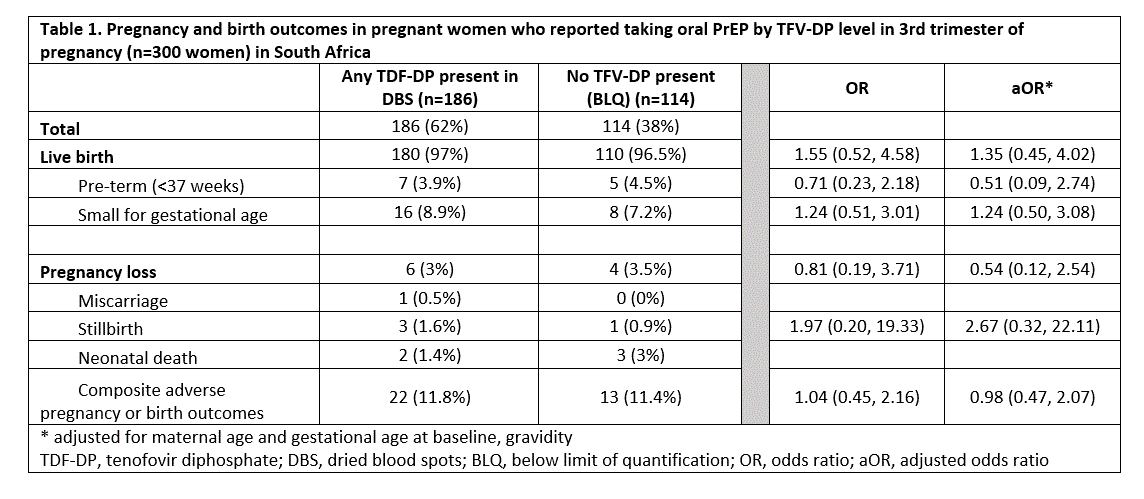
In 300 pregnant women, median age was 26 yrs (IQR=23-32yrs); gestation age at baseline was 16 wks (IQR=12-21wks). Overall, 7.3% had TFV-DP concentrations corresponding to 7 doses/wk (n=22); 27.3% of levels corresponded to 2-6 doses/wk (n=82); 27.3% of levels corresponded to < 2 doses/wk (n=82); 38% had levels below the limit of quantification (BLQ; n=114). Correlates of having TFV-DP concentrations corresponding with >2 doses/week included older age, higher education and condomless sex in past month. Comparing women with any TFV-DP in DBS (n=186; 62%) with those with no TFV-DP (n=114; 38%), 97% had live births (adjusted odds ratio [aOR] for any TFV-DP in DBS vs. BLQ= 1.35; 95%CI=0.45-4.02). There were no differences in pregnancy or birth outcomes by TFV-DP level (Table). The composite adverse pregnancy and birth outcome included pregnancy loss (miscarriage, stillbirth), neonatal death, pre-term ( < 37wks gestation) and infants small for gestational age. Overall, 12% of women with TFV-DP had an adverse pregnancy or birth outcome, compared to 11% in women without any TFV-DP in their 2nd or 3rd trimester (aOR=0.98; 95%CI=0.47-2.07).
Conclusions:
Our study is one of the first to compare objective PrEP use with birth outcomes. Pregnancy and birth outcomes did not differ by PrEP exposure per TFV-DP levels, including pregnancy loss, pre-term birth or small for gestational age. Our study provides further evidence that TDF is safe in pregnancy and highlights the importance of counseling women on the effective use and safety of TDF/FTC as PrEP in pregnancy. Limitation includes the differing time for TFV-DP collection in pregnancy.
Table 1. Pregnancy and birth outcomes in pregnant women who reported taking oral PrEP by TFV-DP level in 3rd trimester of pregnancy (n=300 women) in South Africa