Background:
The cervicovaginal (CV) microbiome has a critical role in women’s health and disease, including HIV acquisition and progression. A healthy cervicovaginal (CV) microbiome is dominated by a single Lactobacillus species that helps maintain a low vaginal pH, prevent outgrowth of harmful bacteria, and regulate immune homeostasis. Bacterial vaginosis (BV) occurs when Lactobacillus is depleted and replaced by an outgrowth of facultative or obligate anaerobes. Women living with HIV (WLWH) have high prevalence of BV-associated bacteria that are linked to vaginal inflammation, higher genital HIV viral loads, and greater HIV shedding. However, the impact of antiretroviral treatment (ART) on the CV microbiome has not been described in depth. In this study, we sought to evaluate the CV microbiome of ARV-naïve WLWH over their first year of ART.
Methods:
CV pellets were collected longitudinally from 83 ART-naïve cisgender Ugandan WLWH at week 0, 8, 24, and 52 of ART. After DNA extraction, the V3-V4 region of the bacterial 16S rRNA gene was amplified by PCR and sequenced using an Illumina NovaSeq platform. Paired end FASTQ files were analyzed using the DADA2 package in R. Reads were binned into amplicon sequence variants (ASVs) and the SILVA taxonomic framework were used to taxonomically annotate them. ASVs were analyzed using the PhyloSeq and DeSeq2 packages in R.
Results:
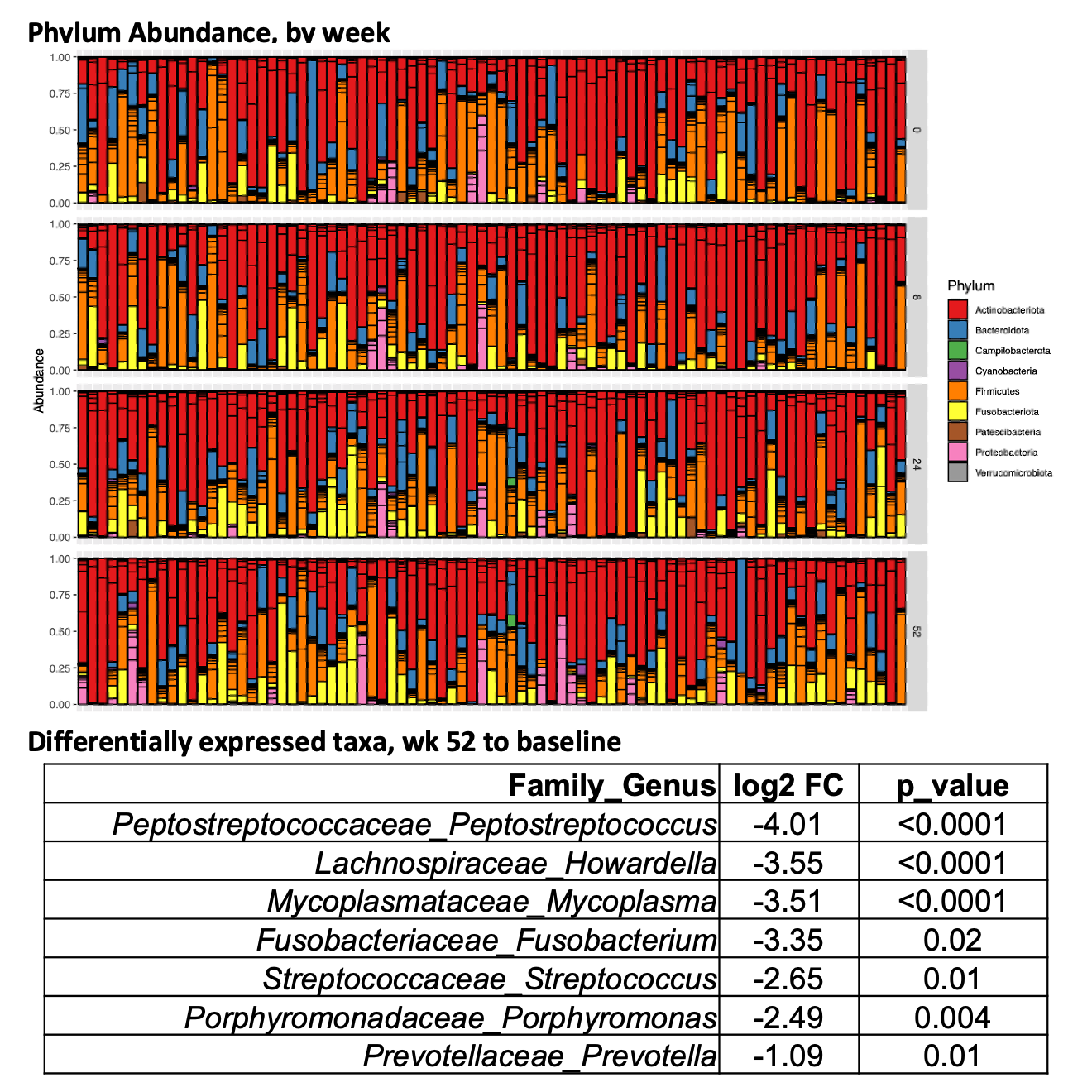
The median age of participants was 31 years and median HIV plasma viral load was 4.4 log10 copies/ml with a CD4 count of 400 cells/ml. ART resulted in a restored median CD4 count of 687 cells/ml after 52 weeks (p< 0.0001) and undetectable viremia in 86% of participants (43/50). Gardnerella was identified as the most abundant family in our dataset with a median relative abundance of 35% at week 0. Gardnerella maintained a high prevalence throughout the study with a median relative abundance of 46, 35, and 35% at week 8, 24, and 52, respectively. Bacterial diversity, measured by Shannon Diversity, at week 52 did not differ from week 0 (p=0.91), although seven genera were significantly less abundant at week 52 compared to baseline including the BV-associated bacteria Peptostreptococcus (log2FC= -4.01, p=< 0.0001) and Prevotella (-1.09, p=0.01).
Conclusions:
Our findings indicate that ART alone does not effectively modulate compositional diversity of the CV microbiome, however, abundance of some BV-specific bacteria was reduced following treatment. These data support exploration of targeted therapeutics to restore the CV microbiome.