Background:
Whether early antiviral therapy reduces the risk of Long COVID is not known. The combination SARS-CoV-2 monoclonal antibodies amubarvimab+romlusevimab (A+R) were highly effective in reducing 28-day all-cause hospitalization/death among high-risk adults with mild-to-moderate COVID-19 in the randomized, placebo-controlled ACTIV-2/A5401 trial. We assessed the impact of A+R on late outcomes including Long COVID in ACTIV-2.
Methods:
A long-term (LT) symptom diary and 2 health-related quality of life questionnaires (EQ-5D-5L and SF-36v2) were completed at week 36. The primary analysis compared the proportion of participants with the composite outcome of self-reported Long COVID (having any COVID-19 symptoms present on a global assessment question in LT diary) at week 36, or hospitalization or death by week 36 between A+R and placebo using regression models with inverse probability weighting to account for incomplete outcome data; supplemental analysis compared the proportion with Long COVID among those alive. Other analyses were restricted to observed data only.
Results:
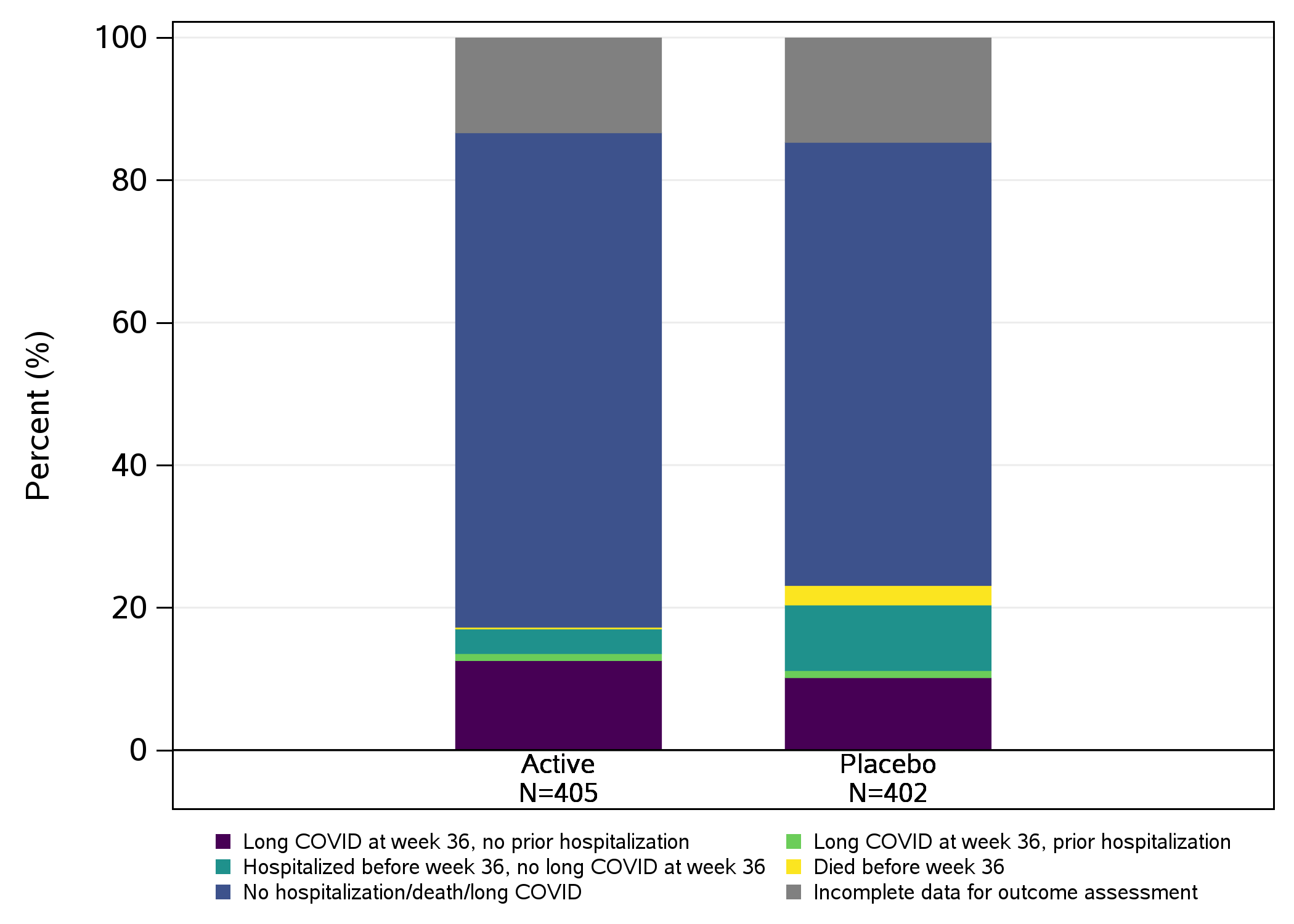
807 were randomized and received A+R (n=405) or placebo (n=402) from Jan-July 2021. At entry, median age was 49 years, 51% were female, >99% cis-gender, 17% Black/African American, 50% Hispanic/Latino, and 9% previously received COVID vaccination. 70 (17%) on A+R and 93 (23%) on placebo met the primary outcome; 113 (14%) had incomplete data for determining the outcome (Figure 1). Accounting for incomplete data, weighted Risk Ratio [wRR]=0.74; 95% CI: 0.56, 0.97; p=0.03. The difference was driven by fewer hospitalizations/deaths in the A+R arm (5%) than placebo arm (15%), particularly by day 28. Excluding 12 participants who died by week 36, frequency of Long COVID was similar in the arms, 16% for A+R and 14% for placebo (wRR=1.09; 95%CI: 0.75, 1.58; p=0.64). There were no differences in the proportions reporting return to pre-COVID health (global assessment) or individual symptoms, or in number of symptoms reported or distribution of worst symptom severity. RRs favored the A+R arm on several EQ-5D-5L domains, but none met statistical significance. No differences were observed on SF-36v2 assessments.
Conclusions:
While A+R was highly effective in preventing all-cause hospitalizations and deaths in high-risk outpatients with mild-to-moderate COVID-19, there was no meaningful effect of treatment on measures of Long COVID at 36 weeks. Additional interventions are needed for Long COVID prevention.
Week 36 Long COVID, Hospitalizations, and Death by Amubarvimab+Romlusevimab (Active) vs Placebo Treatment