Background:
T cells play a critical role in the adaptive immune response to SARS-CoV-2 in both infection and vaccination. Identifying T cell epitopes and understanding how T cells recognize these epitopes can help inform future vaccine design and provide insight into T cell recognition of newly emerging variants. Here, we identified SARS-CoV-2 specific T cell epitopes, analyzed epitope-specific T cell repertoires, and characterized the potency and cross-reactivity of T cell clones across different common human coronaviruses (HCoVs).
Methods:
SARS-CoV-2-specific T cell epitopes were determined by IFNγ ELISpot using PBMC from convalescent individuals with mild/moderate disease (n=25 for Spike (S), Nucleocapsid (N) and Membrane (M)), and in vaccinated individuals (n=27 for S). Epitope-specific T cells were isolated based on activation markers following a 6-hour peptide stimulation, and scRNAseq was performed for TCR repertoire analysis. T cell lines were generated by expressing recombinant TCRs in Jurkat cells and activation was measured by CD69 upregulation.
Results:
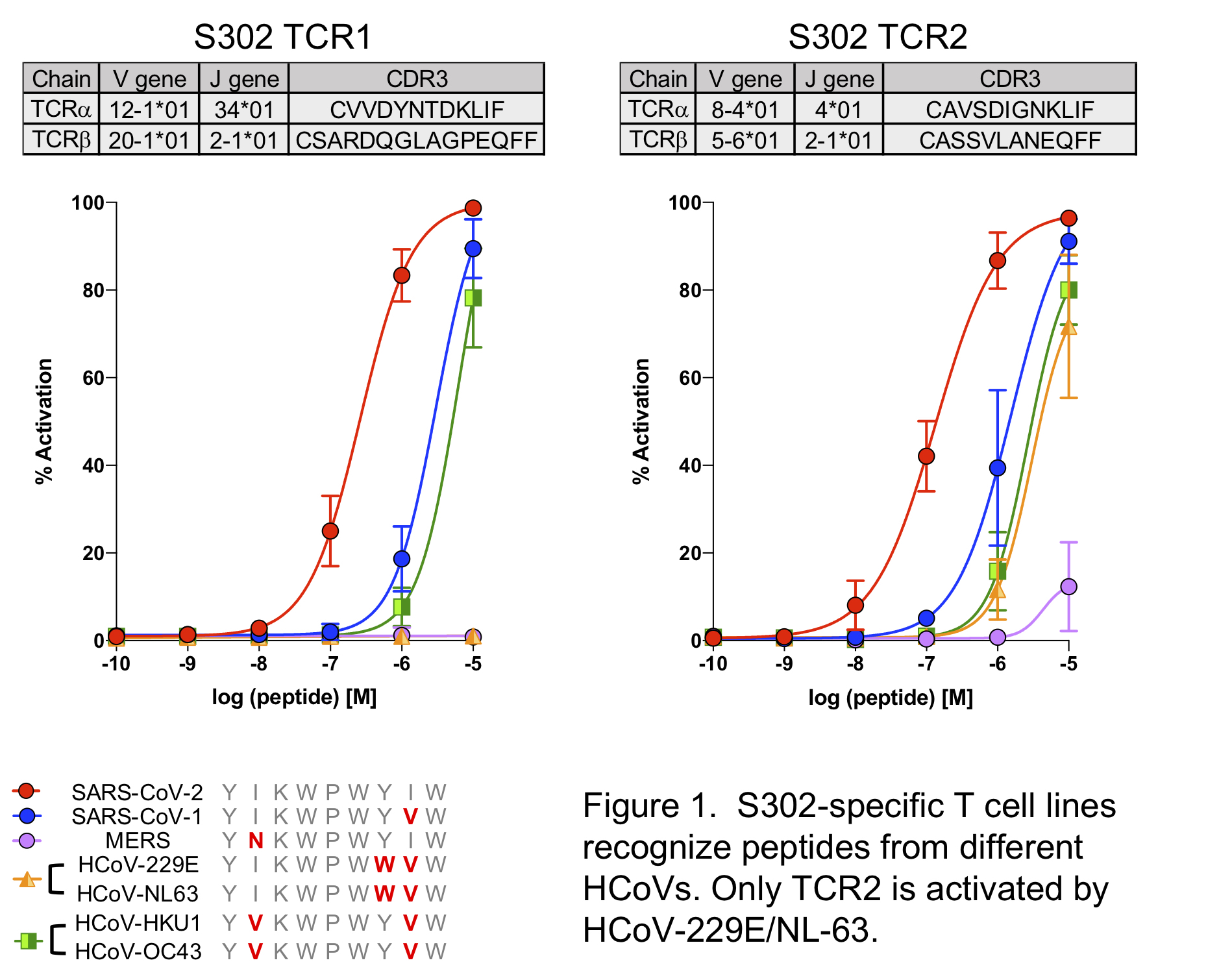
We identified multiple immunodominant T cell epitopes across S, N and M proteins in convalescent individuals. In vaccinated individuals, we detected many of the same dominant S-specific epitopes at similar frequencies as compared to convalescent individuals. T cell responses to peptide S205 (amino acids 817-831) were observed in 56% and 59% of individuals following infection and vaccination, respectively, while 20% and 19% of individuals responded to S302 (a.a. 1205-1219) following infection and vaccination, respectively. For S205, a CD4+ T cell response, we confirmed 8 unique TCRs and determined the minimal epitope to be a 9mer (IEDLLFNKV). While TCR genes TRAV8-6*01 and TRBV30*01 were commonly utilized across the TCRs, we did identify TCRs with unique immunogenetic properties with different potencies of cross-reactivity to other HCoVs. For S302, a CD8+ T cell response, we identified two unique TCRs with different immunogenetic properties that recognized the same 9mer (YIKWPWYIW) and cross-reacted with different HCoV peptides (Figure 1).
Conclusions:
These data identify immunodominant T cell epitopes following SARS-CoV-2 infection and vaccination and provide a detailed analysis of epitope-specific TCR repertoires. The prospect of developing a vaccine that broadly protects against multiple human coronaviruses is bolstered by the identification of conserved immunodominant SARS-CoV-2 T cell epitopes that cross react with multiple other HCoVs.