Background:
The risk of anal cancer is markedly increased in PWH, especially in MSM, who exhibit specific microbiota signatures, possibly contributing to the greater HPV persistence and oncogenic potential. The low specificity of the current screening strategy for detecting high-grade squamous intraepithelial lesions (HSIL) hinders anal cancer prevention. We investigated in anal cytology samples microbiota derivatives associated with HSIL.
Methods:
We recruited a discovery and a validation cohort in 4 clinical sites in Spain and Italy. Study participants were mostly MSM undergoing HSIL screening with high-resolution anoscopy and anal biopsies to confirm HSIL. We extracted the bacterial DNA, proteins, and metabolites from anal cytology samples, where we performed 16SrRNA gene sequencing,mass spectrometry, and targeted metabolite quantification.
Results:
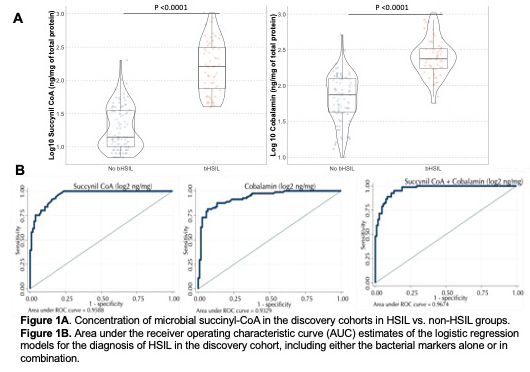
We included 213 participants, 167 in the discovery cohort (70 with confirmed HSIL), and 46 in the validation cohort (25 with confirmed HSIL). Patients with HSIL exhibited an increased abundance of Prevotella copri, while Sneathia sanguinegens were depleted. The microbiota associated with HSIL overexpressed proteins that converged in the production of succinyl-CoA and cobalamin, which levels were consistently increased in subjects with HSIL (Figure 1A). The combination of succinyl-CoA and cobalamin overperformed the anal cytology, improving sensitivity from 91.2% to 96.6%, specificity from 34.1% to 81.8%, positive predictive value from 48.1% to 77.8%, and negative predictive value from 85.3% to 97.3% (Figure 1B). While the anal cytology correctly classified only 59.9% of individuals, the combination of both metabolites improved the classification to 87.7%. This test overcame internal (adjusted AUC 0.877) and external validation. From 98 false-positive cytologic results of succinyl-CoA and cobalamin levels reclassified to true negative results 49 (81.9%). Finally, we demonstrated a greater in vitro production of succinyl-CoA and cobalamin of Prevotella copri –enriched in participants with HSIL– vs. Sneathia sanguinegens –depleted in participants with HSIL–.
Conclusions:
Cobalamin and succinyl-CoA are overexpressed in the anal microbiota of patients with HSIL and show an excellent diagnostic capacity. Their measurement overperforms anal cytology to screen for patients with HSIL. Hence, we discovered two powerful biomarkers, for which readily detection methods can be established, that could improve the current strategy for anal cancer screening.