To optimize South Africa’s HIV response and reach targets of 95% tested, 95% treated, and 95% virally suppressed, numbers initiating and successfully remaining on antiretroviral therapy (ART) must increase. While much effort and resources have been focused on tracing those lost to follow up and returning them to care, little prior work has successfully addressed identifying those most at risk of poor treatment outcomes while they are still engaged in care.
We applied machine learning and modelling algorithms to routinely-collected ART patient data from the SLATE I and SLATE II trials which evaluated same-day ART initiation in 2017-18. Our primary outcome was the probability of a patient’s attending the next scheduled clinic visit. Three classification algorithms were tested: logistical regression, random forest and AdaBoost classifier. Demographic, clinical, socioeconomic, care-seeking behavioural (visit patterns), and laboratory data points were investigated as potential predictor variables. Predictions were scored for accuracy against known outcomes in the source dataset.
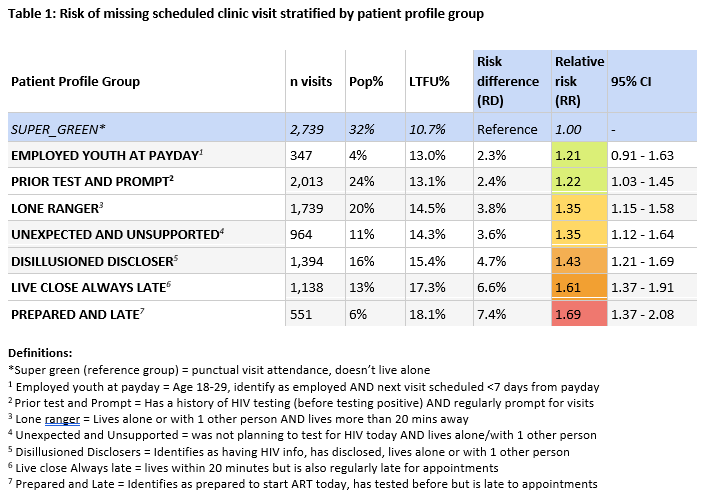
Data from 916 patients who initiated ART were analyzed in 7 models using multiple combinations of input features and classification algorithms. The best model achieved 90% specificity and 69% accuracy and an area under the curve of 0.68 for attendance at next scheduled visit, suggesting that the model correctly anticipated whether a scheduled visit would be attended for 2 out of 3 patients. Prior patient behavior and treatment history were important in predicting visit attendance, while demographic and socioeconomic characteristics were useful in creating patient profiles to stratify groups (Table 1) into risk profiles. Compared to punctual attenders with social support, a patient who is late to previous appointments was 1.69 times more likely to miss a scheduled visit, while an employed patient aged 18-29 with a scheduled visit near payday was 1.21 times more likely to miss the next visit.
If facilities could identify patients at higher risk of loss to care while the patient is still active, micro-targeted interventions could be implemented more efficiently and pro-actively, rather than only after a patient is lost. Predictive models may allow providers to combine existing medical record data on prior behavior and treatment history with a simple demographic and socioeconomic questionnaire to assess individual risk and offer personalized, differentiated care.