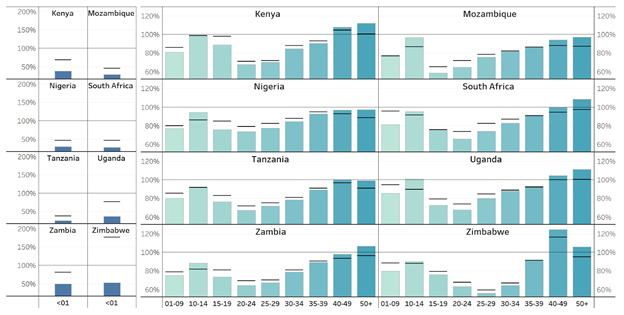
Retention of clients on HIV treatment is essential for achieving the second and third of the UNAIDS 90-90-90 goals. The President’s Emergency Plan for AIDS Relief (PEPFAR) requests programs to monitor age-specific retention using aggregated data, in order to identify demographic groups who may be experiencing treatment interruptions at higher rates. However, retention measures may be distorted by normal aging into and out of age bands. This analysis quantifies the impact of aging on PEPFAR retention estimates for eight PEPFAR priority countries: Kenya, Mozambique, Nigeria, South Africa, Tanzania, Uganda, Zambia, and Zimbabwe.
We used data submitted to PEPFAR in 2018 and 2019 on people living with HIV (PLHIV) currently receiving antiretroviral therapy (ART) (TX_CURR), PLHIV newly enrolled on ART (TX_NEW), and UNAIDS Spectrum Modeling for the number of PLHIV on ART by one-year age band. We calculated proxy retention as currently calculated by PEPFAR [TX_CURR 2019 / (TX_CURR 2018 +TX_NEW 2019)] and compared it to the proxy retention but adjusted for aging (‘aging adjusted PEPFAR retention’ [AAPR]) [TX_CURR 2019 / (aging-adjusted TX_CURR 2018 + TX_NEW 2019)]. To calculate the aging-adjusted TX_CURR 2018, first we predicted baseline ART in 2019 using Spectrum estimates for 2018. Next, we aggregated predicted baseline 2019 and 2018 in 2018 age band groups (<1, 1-9, 10-14, 15-19, 20-24, 25-29, 30-34, 35-39, 40-49, 50+). Finally, we took the proportion of predicted baseline 2019 relative to 2018, which we applied to the TX_CURR 2018.
After adjusting for aging, estimates of retention on ART increases for most age bands compared to the current PEPFAR retention proxy approach, except for 10-14 and >40. Adjusted for aging, proxy retention on average increased for <1 by 37.2% (AAPR: 73.8%); 1-9 by 3.3% (AAPR: 83.0%); 15-19 by 6.8% (AAPR: 81.5%); 20-24 by 6.0% (AAPR: 72.8%); 25-29 by 4.6% (AAPR: 76.1%); 30-34 by 3.1% (AAPR: 83.6%); and 35-39 by 1.2% (AAPR: 91.8%). Proxy retention adjusted for aging on average decreased for 10-14 by 2.8% (AAPR: 91.7%); 40-49 by -4.5% (AAPR: 98.7%) and 50+ by 10.0% (AAPR: 94.8%).
Normal aging can distort age-band retention estimates, especially at the extremes of ages. Assessment of retention for <1 age band needs special treatment, as all infants will age out over the course of one year. Treatment programs need systematic methods to account for aging to better assess and optimize continuity of care across the lifespan.