Tuberculosis (TB) accounts for a large burden of morbidity and mortality among persons living with HIV (PLWH). Conventional methods of TB diagnosis, including smear microscopy and Xpert MTB/RIF have lower sensitivity in PLWH. Novel high-throughput approaches, such as miRNAomics and metabolomics, may advance our insights into subclinical and difficult to diagnose TB, especially in very advanced HIV.
We conducted a case-control study leveraging REMEMBER, a multi-country, open-label randomized controlled trial comparing 4-drug empiric TB treatment with isoniazid preventive therapy in PLWH initiating ART with CD4 cell counts <50 cells/?L. Active TB was ruled out at baseline. A total of 23 Cases (incident TB within 48 weeks post-ART initiation) were site-matched with up to 2 Controls. We performed miRNA next generation sequencing (QIAGEN), liquid chromatography-mass spectrometry quantitative metabolomic analysis (Metabolon, Inc.), and multiplex immunoassays (Luminex) on serum samples obtained at time of TB diagnosis. Multi-omics data were integrated, and the decision tree algorithm was used to identify the best model for TB diagnosis. The accuracy was measured by receiver operating characteristic (ROC) curve and area under the curve (AUC).
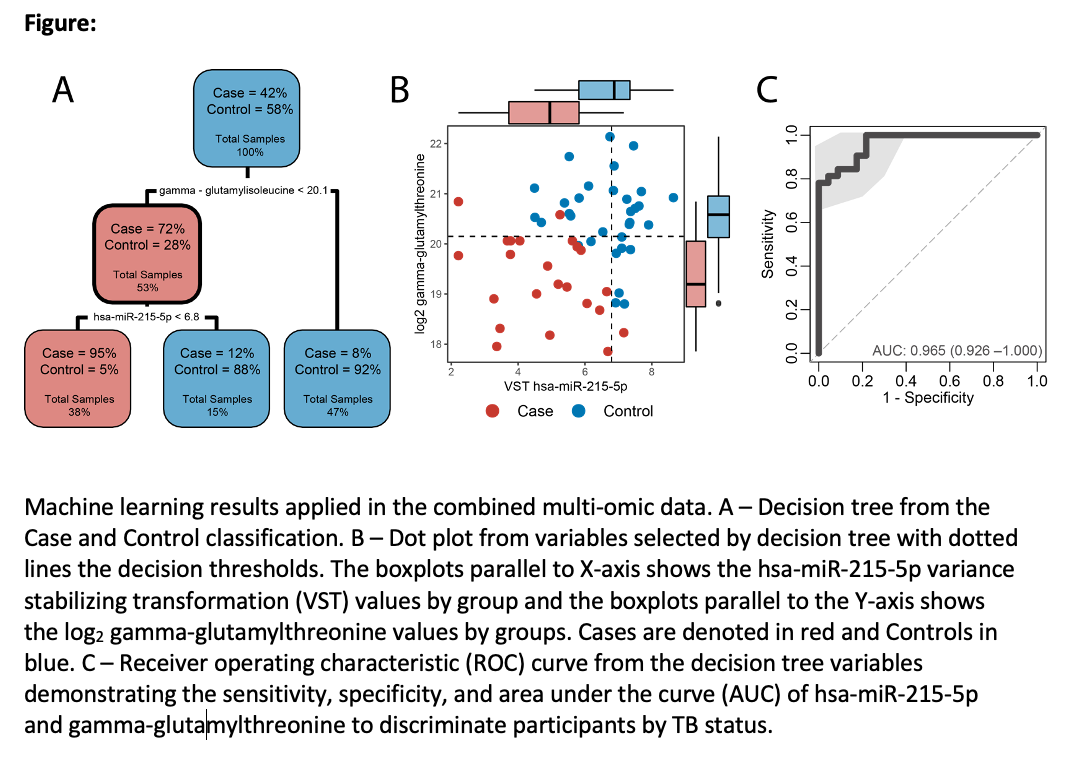
The majority of participants were from South Africa and India. The median time to TB diagnosis was 4.6 weeks (IQR 2-16.1), with 12 pulmonary and 11 extrapulmonary cases. Differentially expressed miRNA analysis revealed 11 altered miRNAs, with fold change higher than ±1.4 in Cases relative to Controls (P<0.05). Differentially altered metabolite analysis showed no significant alterations in metabolites between Cases and Controls. We found higher TNF? and IP-10/CXCL10 in Cases (p=0.011, p=0.0005), and higher MDC/CCL22 in Controls (p=0.0072). A decision tree algorithm identified gamma-glutamylthreonine and hsa-miR-215-5p as the optimal variables to classify incident TB Cases (AUC 0.965). hsa-miR-215-5p, which targets genes in the TGF-? signaling pathway, was downregulated in Cases. Gamma-glutamylthreonine, a breakdown product of protein catabolism, was less abundant in Cases. Integration of cytokine markers did not improve the AUC.
Use of a machine learning approach in the multi-omics data from advanced HIV participants revealed two variables with the ability to accurately discriminate TB Cases from Controls.