Despite antiretroviral (ARV) therapy, HIV persists in lymphoid tissue throughout the body. Lymph node ARV penetration is crucial for HIV treatment and eradication, but sampling these tissues is highly invasive and costly. Here, we investigate whether a novel physiologically-based pharmacokinetic (PBPK) model can predict the concentration of tenofovir (TFV) in lymph nodes of nonhuman primates (NHPs) and humans.
Model development followed the same stepwise approach in NHPs and humans. First, a whole-body PBPK model of TFV was developed in PK-Sim using built-in physiologic parameters, drug parameters, and plasma clearance estimates. The model was fit to observed data of TFV concentrations in plasma and tissue (brain, ileum, rectum) by optimizing interstitial-intracellular permeabilities. The final plasma model was exported from PK-Sim to MoBi, where a lymph node compartment was added. Physiologic parameters describing the lymph node were obtained from literature. The lymph node model was exported back to PK-Sim, and fit to observed data by optimizing the lymph node interstitial-intracellular permeability (P[sub]LN[/sub]) and tissue:plasma partition coefficient (Kp[sub]LN[/sub]). Model acceptance was determined by PK parameter validation against reference values; ratios within 0.5-2 were considered predictive.
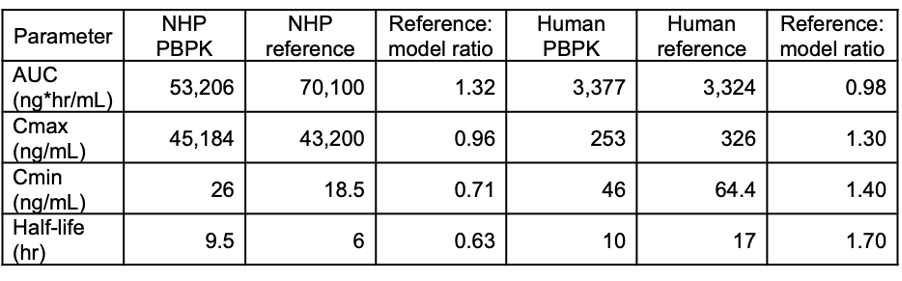
Mean PK parameters, reference values, and ratios for the final NHP and human lymph node models are summarized in the table. Both species’ models passed acceptance criteria across all PK parameters, within 0.6-1.7 fold of directly measured values. Optimized PLN increased from baseline (1.29e-6 cm/min) in both the NHP (3.74e-5 cm/min) and human models (8.66e-6 cm/min), indicating that a permeability-limited model best described TFV kinetics in the lymph node. Optimized KpLN ?1 in NHPs (0.95) and humans (0.81), and was similar to the partition coefficients of other organs, consistent with TFV’s volume of distribution (~0.8 L/kg).
Our novel PBPK model is the first to predict TFV concentrations in lymph nodes of NHPs and humans. A permeability-limited lymph node model and KpLN ?1 accurately captures TFV’s rapid diffusion between plasma and tissue, which is expected based on its low lipophilicity, molecular weight, and minimal protein binding. Our PBPK model can be used to describe the lymph node distribution of ARVs with similar properties (FTC, 3TC), or to test new formulations aimed at increasing lymphatic penetration.