Doravirine (DOR) is a new HIV-1 non-nucleoside reverse transcriptase inhibitor (NNRTI) that has demonstrated a good efficacy and safety profile in clinical trials. Initial pharmacokinetic studies demonstrated a time to maximal concentration of 1–5 h, not extensive binding to plasma proteins (76%) and poor solubility in water. In animal models the tissue distribution was assessed using 14C-labelled DOR. Low levels of radioactivity were observed in the brain suggesting that DOR does not readily cross the blood-brain-barrier. We determined DOR levels in cerebrospinal fluid (CSF) as well as HIV viral load in this compartment in HIV-1 virologically suppressed patients.
This is a single-arm, open-label, single-center study. After an initial assessment, 15 participants switched from stable ART to Emtricitabine/Tenofovir alafenamide (FTC/TAF) plus DOR 100 mg OD orally. At week 4, blood and CSF samples were collected 24 h post dose, when DOR concentrations are expected to be lowest. Total DOR concentrations in plasma and CSF were determined using a validated LC-MS method. Unbound DOR concentrations were determined using Rapid Equilibrium Dialysis. HIV RNA was measured in plasma and CSF by RT-PCR (LLQ 20 copies/mL).
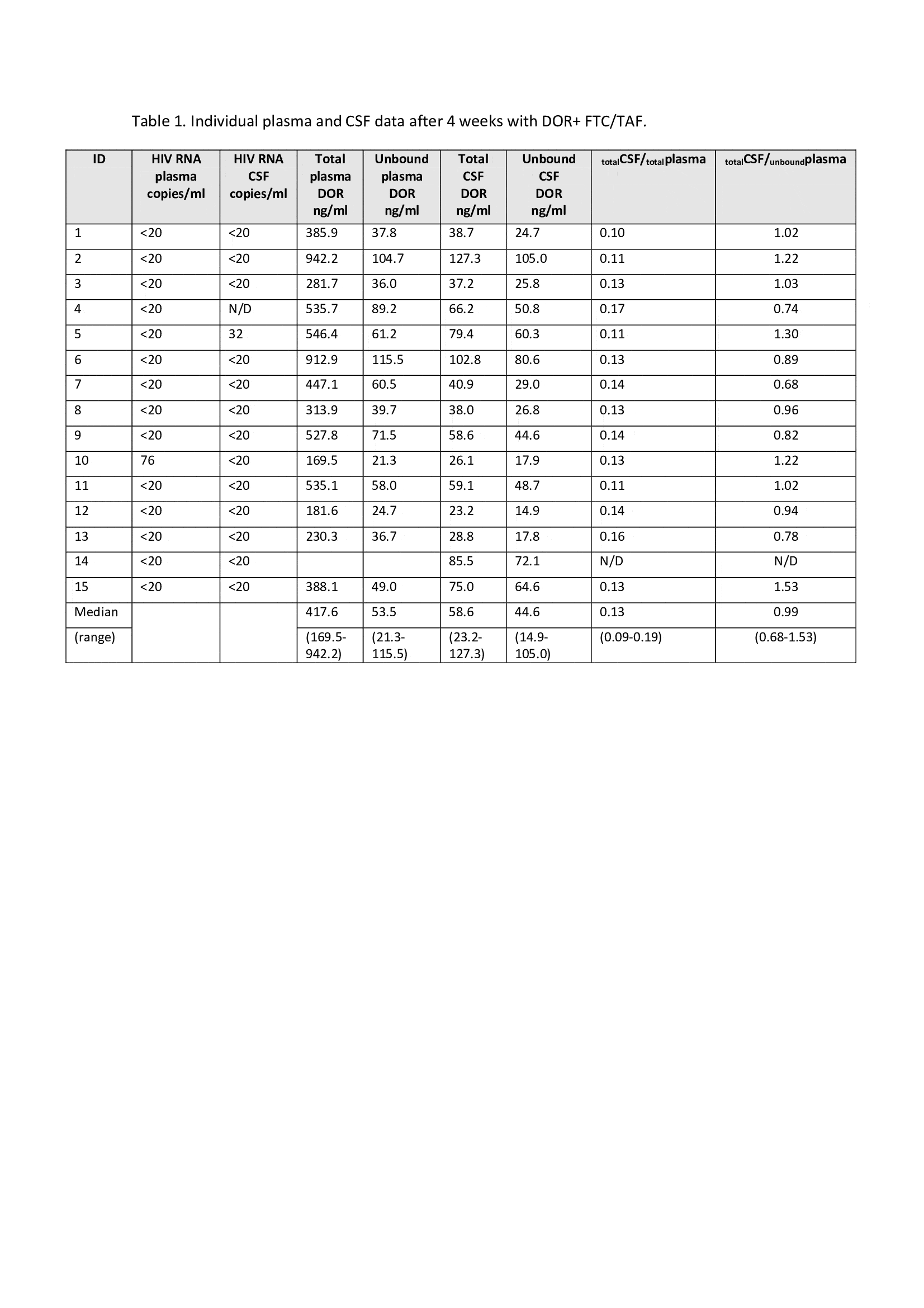
A total of 14 plasma and 15 CSF samples were collected. Median age was 47 years (27-65), 86% were male. At baseline, median CD4 cell count and HIV viral load in plasma were 773 cells/uL (372 – 1744) and <20 copies/ml respectively. Most patients switched from INSTI based regimens [Bictegravir (5); Dolutegravir (4) and Elvitegravir (3)]. At week 4, only one patient had detectable viral load in CSF (32 copies/ml) while undetectable in blood plasma. The DOR unbound fraction in plasma and CSF were 12.8% and 76.1% respectively. DOR total CSF/total plasma ratio was 0.13. DOR total CSF/unbound plasma was 0.99, suggesting that DOR crosses the blood brain barrier primarily via passive diffusion (Table 1).
Total and unbound trough DORA concentrations in CSF exceeded the EC50 value against WT virus (5.1 ng/mL) by 11.4 and 8.7-fold respectively, suggesting that DOR given in combination with FTC/TAF may contribute to inhibit viral replication in this compartment.