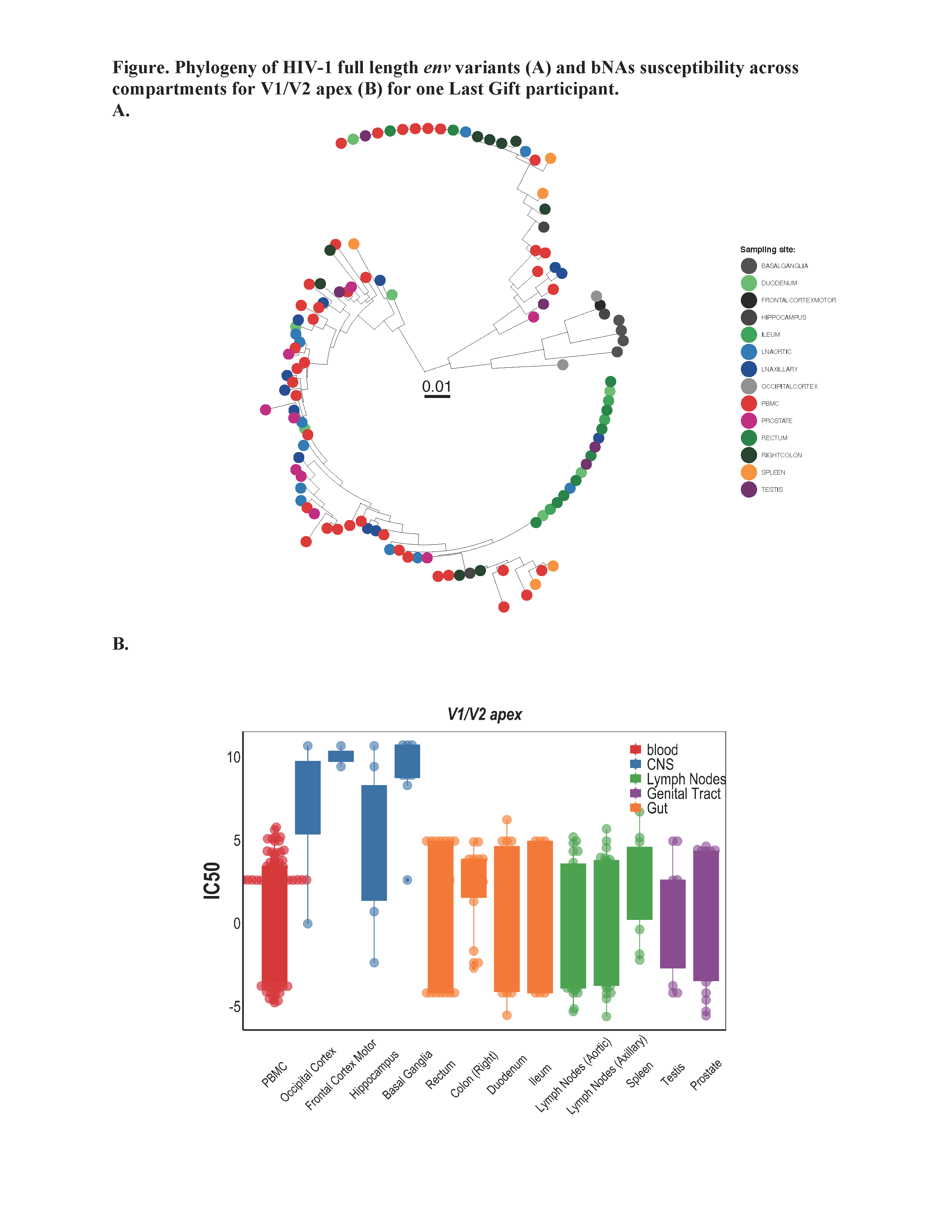
HIV-1 genetic diversity and the presence of archived provirus that harbors escape mutations to antibodies are major obstacles for the clinical use of broadly neutralizing antibodies (bNAbs) to treat HIV-1 and for the use of bNAbs as interventions to clear reservoirs. This study aimed to characterize the viral reservoir to its susceptibility to antibody neutralization across peripheral blood mononuclear cells and deep tissues.
We analyzed near full length HIV env sequencing data generated from antemortem blood and postmortem tissues from participants in the Last Gift autopsy cohort using a Bayesian machine-learning model. The model uses HIV-1 envelope protein sequences and approximates glycan occupancy information as variables to quantitatively predict the half maximal inhibitory concentrations (IC50) of bNabs. Using linear mixed effect models, this allowed us to map the landscape of neutralization resistance across each person’s tissue reservoirs for 9 distinct bNAbs (targeting the CD4 binding site, V3-glycan, V2-apex and MPER) and grouped tissue sites (i.e. central nervous system [n=4 sites], genital tract [n=4], gut [n=8] and lymph nodes [n=9]) within and across participants.
We analyzed a total of 655 Env sequences (mean 109 [95%I:72.7 -145.6]/participant) across 32 distinct blood and tissue sites (mean 20 [95%CI:14.4-26.6] sequences/site) from 6 participants. We observed expected heterogeneity of predicted neutralization susceptibilities across participants but also across bNAb classes and tissues within participants. Neutralization susceptibilities were within the ranges that have been described for each tested bNAb, but for some antibodies, targeting the V2-apex or the V3-glycan, the predicted neutralization pattern differed between tissue compartments (p<0.001). In 5 participants that had remained suppressed on ART until their death, the breadth of neutralization susceptibilities in the PBMC reservoir did not differ from what was found in tissues. This observation was consistent across antibody target classes (P>0.1).
In persons with HIV (PWH) suppressed by ART, the landscape of predicted viral resistance to bNAb neutralization in the PBMC reservoir seems to match to what is observed in tissues. These data suggest that sampling the blood might be sufficiently representative of the diversity of the viral reservoir within an PWH to facilitate the selection of personalized bNAb combinations for therapeutic approaches.