The initial cellular targets of HIV in lymphoid tissues remain unclear. Here, we used a single-cell approach to retrieve the phenotype, HIV envelope and T-cell receptor (TCR) sequences of HIV-infected cells in blood and lymph nodes from individuals at the earliest stage of HIV infection, prior to ART initiation.
Cross-sectionnal paired blood and lymph nodes samples from 21 acutely infected participants (n=3-5 individuals/Fiebig stage [I to V]) and 4 untreated chronically-infected controls enrolled in the RV254/RV304 studies (Bangkok, Thailand) were analyzed. The phenotype of productively infected (p24+) cells was analyzed by multiparameter flow-cytometry (HIV-Flow). Clonotype and viral characterization of single sorted infected cells was determined by TCR? and Env (C2V5) sequencing, respectively.
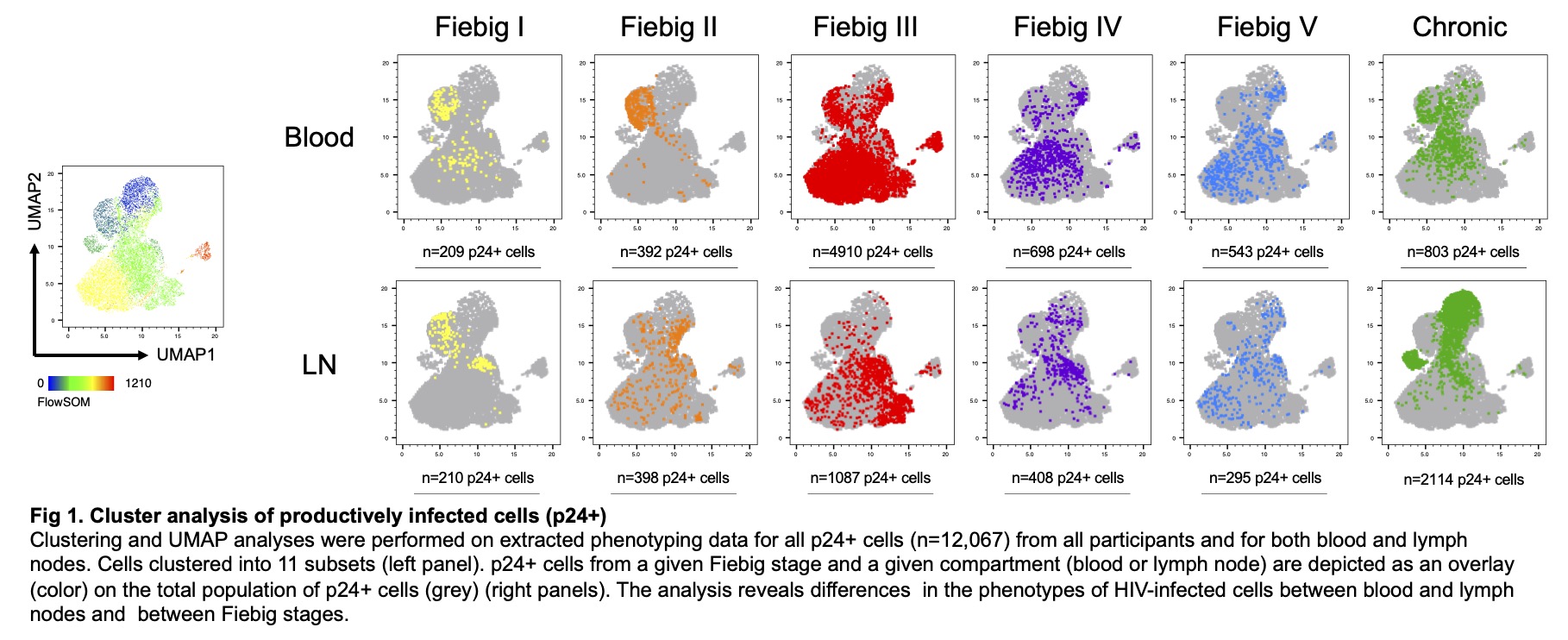
Productively infected p24+ cells were detected in blood and lymph nodes since the earliest stage of acute infection (Fiebig I) and their frequency increased with time. Phenotypic analysis of 12,067 p24+ cells from blood and lymph nodes showed that memory cells expressing CCR5, Ki67, ICOS, PD-1 and CXCR3 were preferentially infected at all stages. UMAP analysis revealed that infected cells were distributed in 11 cell clusters, and that their relative contribution to the overall pool of infected cells evolved rapidly across the different stages of acute infection and differed between blood and lymph nodes (Fig. 1). Although T follicular helper (Tfh) cells and particularly germinal center-Tfh were preferential HIV targets in lymph nodes during chronic infection, their contributions to the initial pool of infected cells were modest in acute infection. HIV-Env sequencing of 582 single-sorted p24+ cells showed a homogeneous population of HIV variants across blood and lymph nodes during all stages of acute infection, which diversified during chronic infection. In sharp contrast, distinct TCR? were found in >99% of the cellular HIV targets (n=1,006 p24+ cells), indicating that initially infected cells were the product of independent infection events and that expansions in the pool of productively infected cells were rare early in infection.
HIV-infection is established by a limited number of HIV variants infecting a large pool of phenotypically and clonotypically distinct memory T cells in both blood and lymph nodes. The phenotype of infected cells differed between Fiebig stages, suggesting a rapid temporal evolution in HIV cellular targets during acute HIV infection.